Showing posts with label Kachchh weaving. Show all posts

Monday, 14 April 2014

The Great Prints of Kutch- Ajrakh

Various small villages in Kutch are hugely moored in forms on traditional art. Right from Rogan Art to Weaving, rare art forms have passed down generation after generation. Ajrakh, an art deeply rooted in ancient times, is one such practice. In fact, its origins can be traced back to the Indus valley civilization.


Even though the art seems to have emerged in Sindh, it has traveled down to Rajasthan and Gujarat over the centuries. Ajrakh has different meanings, one of which means to ‘keep it today’. During the olden days the color blue was a dominating color used and hence in Sindh Ajrakh was associated with Indigo.


Complex geometric patterns were used to create starry constellations in Indigo, Madder (a red dye or pigment obtained from the root of the Madder, or a synthetic dye resembling it), Black and White across lengths of cloth. The motifs and shapes used are a vestige of Islamic architecture’s intricate windows and trefoil arches. Ajrakh is a time-honored emblem for the local communities of Kachchh. Communities like the Rabaris, Maldharis, and Ahirs wear Ajrakh printed cloth as turbans, lungis, or stoles. It was given as a gift for the Muslim festival of Eid, for bridegrooms, and for special occasions.
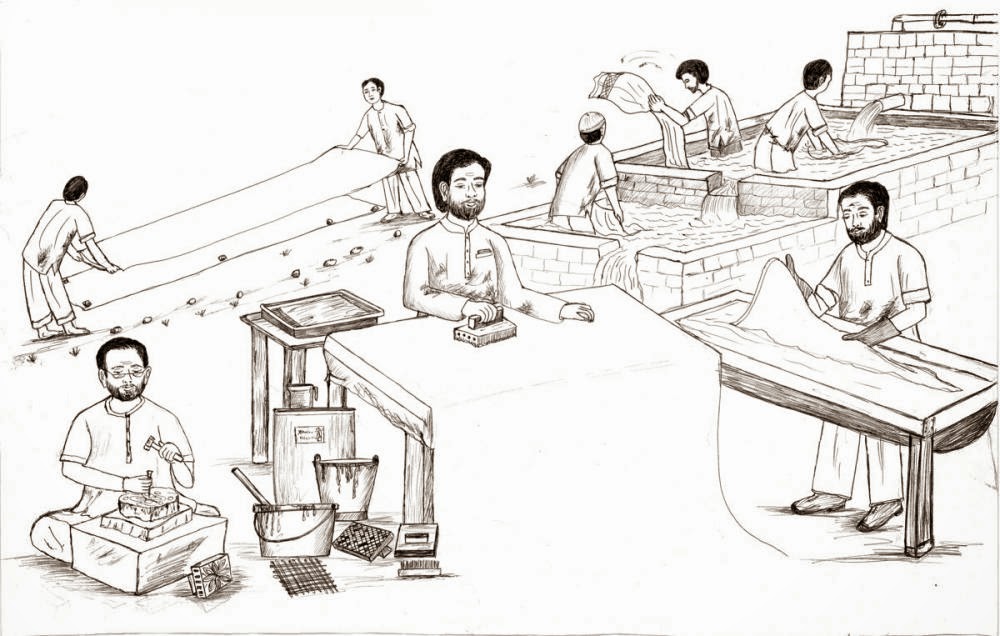

Preparing the cloth is a sixteen step process and takes days, which involves washing, dyeing, printing and drying. A high level of skill and concentration is required in order to keep the colors even. The fabric is first soaked in a mixture of dung, oil and water to make it soft. Left for days to dry, the fabric is re-soaked in more natural ingredients to bleach preparing it for printing.


A wooden block craved with traditional designs is selected by an artisan, on which the first bock is coated in lime and Acacia gum which acts as a resist when pressed on the cloth at regular intervals. Selecting and coating the blocks in dye, aligning and pressing carefully are critical parts of the procedure.  


Natural colors are used, some of which are pomegranate seeds, gum, Harde powder, wood, flour of Kachika, flower of Dhavadi, alizarine and locally cultivated Indigo. Jaggery and gram flour are used for Black designs; alum and tamarind for Red. After each layer of print the cloth is rinsed and sun-dried. On completion, the cloth is washed and dyed in natural colors and finally laid out for drying in the sun.


Today the Khatri community appears to be have monopolized the art in Gujarat. They have passed the teaching for nine generations and Dr. Ismail Mohammad Khatri is one of the few with the knowledge of the art and will later pass it down to his sons as well.


Friday, 11 April 2014

Kachchhi artisans weaving magic

India was once a thriving place of art and culture, but modern India is heavily influenced by the West. Thankfully there are parts of the country which practice art that reflects our traditions. Nirona village in Kutch, Gujarat is a village just like any other, except for the fact it practices centuries old art. The colorful and vibrant village still practices Rogan art, Lacquer art, Copper art and much more.


The small dusty village attracts a number of tourists thanks to their weaving skills. Traditionally kachchhi weavers come from the Marwada and Maheswari communities. The two diversified into different directions, while the Maheshwaris moved towards the art of mashroo the Marwada became well known for Kachchhi


Over the years the small community specialized in crafting woven textiles, leather and woodwork.


Taking inspiration from the community culture, kachchhi woven fabric mirrored the shapes of musical instruments, the footsteps of an animal herd and other designs. Motifs names like vakhiyo, chaumukh, satkani, hathi and dholki are reminiscent of rural images. 

The process starts with shearing the wool from the sheep and is washed and dried readying it to turn it into yarns for weaving. 


The process of carding converts the rough wool into a thin, clean, homogeneous strip which is easily spun into a yarn of equal thickness. Creating this wrap takes days, which includes dyeing too and women play a major role in this.


upright loom
Kachchhi weaving was generally done on Panja loom by hand. Later shuttle looms were used, an advanced technology. There are two types of shuttle looms- the upright loom for coarser fabric and the pit loom for finer fabric that are used. 

pit loom
Designs were created directly on looms through sequential movements of pedals. Blending white and black in a certain proportion creates different shades of grey from which different motifs, stripes and checks are made. Knitting has attained a different level of fabric construction altogether with the motifs getting three dimensional.  


The weaving market have drastically changed, over the changing years weavers have had to become dependent on outside markets for raw materials. Diverting from the original raw materials they now use silks, rayons and acrylic yarn. 


The rarity of the weaving art has made it more alluring and even though there are glimpses of contemporary touches, like designer cushion covers or even chairs for that matter, there is nothing compared to the old school designs!