Showing posts with label Rogan art. Show all posts

Monday, 14 April 2014

The Great Prints of Kutch- Ajrakh

Various small villages in Kutch are hugely moored in forms on traditional art. Right from Rogan Art to Weaving, rare art forms have passed down generation after generation. Ajrakh, an art deeply rooted in ancient times, is one such practice. In fact, its origins can be traced back to the Indus valley civilization.


Even though the art seems to have emerged in Sindh, it has traveled down to Rajasthan and Gujarat over the centuries. Ajrakh has different meanings, one of which means to ‘keep it today’. During the olden days the color blue was a dominating color used and hence in Sindh Ajrakh was associated with Indigo.


Complex geometric patterns were used to create starry constellations in Indigo, Madder (a red dye or pigment obtained from the root of the Madder, or a synthetic dye resembling it), Black and White across lengths of cloth. The motifs and shapes used are a vestige of Islamic architecture’s intricate windows and trefoil arches. Ajrakh is a time-honored emblem for the local communities of Kachchh. Communities like the Rabaris, Maldharis, and Ahirs wear Ajrakh printed cloth as turbans, lungis, or stoles. It was given as a gift for the Muslim festival of Eid, for bridegrooms, and for special occasions.
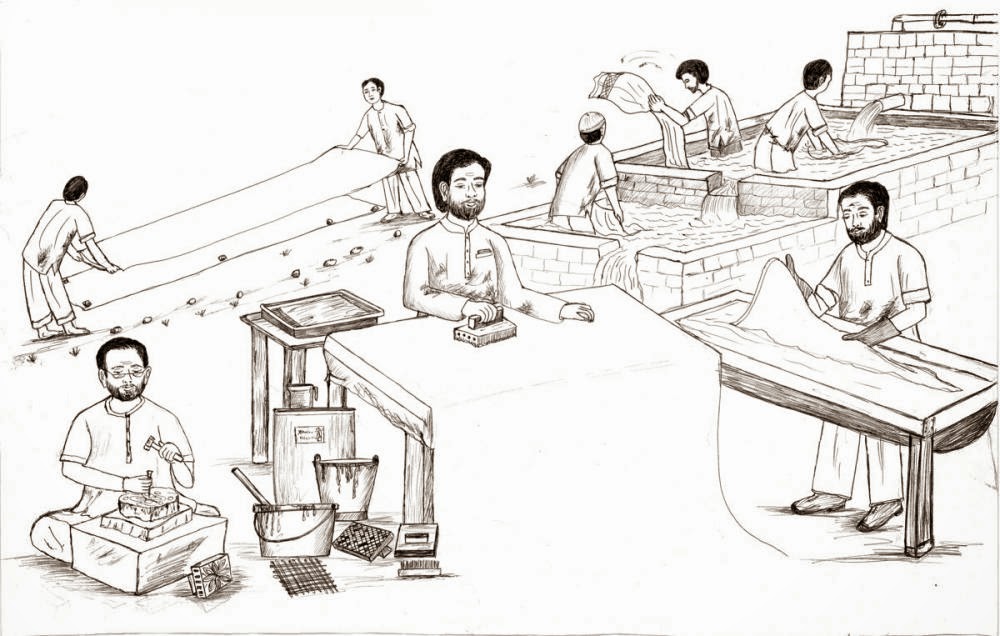

Preparing the cloth is a sixteen step process and takes days, which involves washing, dyeing, printing and drying. A high level of skill and concentration is required in order to keep the colors even. The fabric is first soaked in a mixture of dung, oil and water to make it soft. Left for days to dry, the fabric is re-soaked in more natural ingredients to bleach preparing it for printing.


A wooden block craved with traditional designs is selected by an artisan, on which the first bock is coated in lime and Acacia gum which acts as a resist when pressed on the cloth at regular intervals. Selecting and coating the blocks in dye, aligning and pressing carefully are critical parts of the procedure.  


Natural colors are used, some of which are pomegranate seeds, gum, Harde powder, wood, flour of Kachika, flower of Dhavadi, alizarine and locally cultivated Indigo. Jaggery and gram flour are used for Black designs; alum and tamarind for Red. After each layer of print the cloth is rinsed and sun-dried. On completion, the cloth is washed and dyed in natural colors and finally laid out for drying in the sun.


Today the Khatri community appears to be have monopolized the art in Gujarat. They have passed the teaching for nine generations and Dr. Ismail Mohammad Khatri is one of the few with the knowledge of the art and will later pass it down to his sons as well.


Monday, 31 March 2014

The Forgotten Art - Rogan

The influence of western culture is all too visible in our country, which has its benefits. But the drawback to this ever-increasing westernization is the slow death of some of the best art forms of our own land. Fortunately in places like Nirona, a dusty, dry village in Kutch, the art of Rogan is still alive. A rare and intricate art form, Rogan is an oil-based painting done on cloth.


Practiced for nearly three hundred years, the history of this art form is vague. Said to have originated in Persia, Rogan in Persian literally means oil based painting. The traditional Rogan flower motifs and designs speak of a Persian influence. Peshawar, Lahore, Punjab, Baroda and Kutch were some of the states where the art was practiced. But over the centuries it has faded away and at present Nirona is the only place left where the art still persists. Passed down seven generations, the sons of the Khatri family are the only one continuing the legacy. 

Abdul Gafoor (right) and his uncle Hasan display Rogan art works

Used as a substitute for embroidering, Rogan painting on cloth gives the impression of embroidery. The effect is generated due to the surface application of paste which has an embossed and shiny look akin to embroidery. Rogan is used to decorate mostly the garment of bridal trousseau like Ghagharas, Odhana, Chabla, and Dharajo. Bed sheets, pillow cases, quilts, wall-hanging are also made along with saris. 

Abdul Gafur Khatri

Rogan has an elaborated method, of which making colors is extremely critical. Castor oil is heated for over twelve hours and casted into cold water, this produces a thick residue called ‘Rogan’ which is then mixed with colors. 


During ancient times only indigenous colors from flowers, soil or rocks were used, now however ready-made pigmentation are available. 


Sitting crossed legs on the floor with only one’s hand to support the cloth is the way to create the magnificent design. The delicate design is created by using stylus or wooden stick on one half of the cloth, which is then folded carefully on a center line, pressing lightly and effectively stamping the design on the remaining half of the cloth. 


Rogan is on the verge of extiction, but not completely vanished mostly because of the attraction it holds for tourists. The ancient, beautiful and intricate art is a reflection of our culture and heritage that needs to be revived and preserved.